
News
Collective Network under auspice of ISCP Pensions Meeting on MAY 28th 2024
The Irish Senior Citizens Parliament hosted a meeting to bring together member organisations affected by the lack of a voice regarding their occupational pension. This has resulted in loss of income for many people in an environment of ongoing cost of living increases and hikes in energy costs.
The ISCP formed a collective network some three years ago to address the lack of engagement with pensioners regarding changes to their pension provision. The ISCP supports the progression of the Industrial Relations (Provisions in Respect of Pension Entitlements of Retired Workers) Bill 2021 which is sponsored by Brid Smith. The Bill is before the DAIL and ISCP and the Collective Network of Retired Staff Associations have campaigned heavily to have this progress through all its stages. If passed, the Bill will address the fundamental right of pensioners to be at the table when any decision effecting their pension is being decided. Currently, the Bill is at second stage and is awaiting a report from the Joint Committee.
We thank UNITE for their support in providing the venue on Tuesday 28th of May. We had a full house and were delighted with the turnout from across the country and in particular the engagement of the members on the key issues. The meeting was opened by Pat Mellon, ISCP National Coordinator, who voiced the ongoing commitment of the ISCP to seeing the BILL passed. Eileen Sweeney gave a detailed overview of the work to date on the campaign and Pat welcomed Brid Smith, who took members through the history behind the Bill and its progression to the current stage. She highlighted the disrespect shown to older people by the lack of engagement of the Government on this key issue.
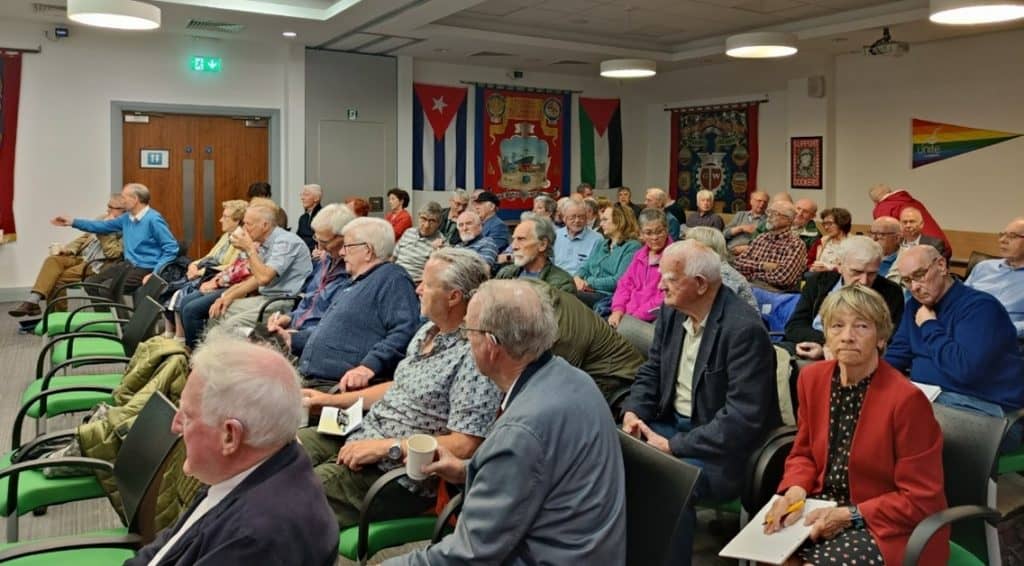
Dr Nat O’Connor from Age Action, whom the ISCP work with on many campaigns, highlighted the reality of income for older people.
“If we look at PAYE income—income that is subject to tax but not including the state pension—of people at the age of 70, the median income—the middle point if you lined people up from lowest to highest income—is €8,136. Half of people at the age of 70 have an income less than that, not including the state pension, but an occupational or private pension income of €8,136 or less. At age 80, it’s €7,700 or less. That’s the middle point. Half of people have more, and half have less.”
In 2022, one in five people aged 65 or older were ‘at risk of poverty’; that is, an income below the poverty line. One in three older people living alone had an income below that line. Dr. O’ Connor went on to explain
“We are sometimes told we have a very generous state pension, but when you look at the European statistics, at income replacement, it tells a different story. Income replacement looks at the income of people in their late 60s and compares this, as a percentage, with the income of people in their 50s. So, to what extent is the pension income replacing work income. You don’t expect it to replace 100%, but the European average is 58%—on average, across Europe, pensions (from all sources) replace 58% of the working income of people in their 50s. In Ireland, it’s 38%—the second lowest in the European Union.”
“Some people like to say that inflation is going down. The inflation rate is a smaller number than it was. But prices are not going down, because it is still a positive number. Inflation is still 2-3%, therefore prices are going up 2-3%. And is your income going up 2-3%? If it’s not, then your spending power is going down. And with 24% inflation, between 2020 when it started, through to the end of next year, then €100 in your hand will buy you what around €80 would have bought you in 2020. So you’ve had the cuts (to state occupational pension funds through the pension levies) and inflation.” The full report from Dr O’Connor is available, so please contact us if you would like more information.
The meeting was addressed by some of the members of the Collective Network on the impact of loss of earnings and having no voice at the table. Paddy Fagan spoke about pension poverty arising from the cuts over the years. John Nugent expressed the urgent need to ensure the lack of engagement by the Government on this issue is addressed.
We thank all who took part in the discussions following the panel inputs and we hope to see you all engaging with your local politicians to create the need to have this Bill passed and to end the inequality and discrimination faced by retired workers and employees.
Double Date with Leinster House Debates
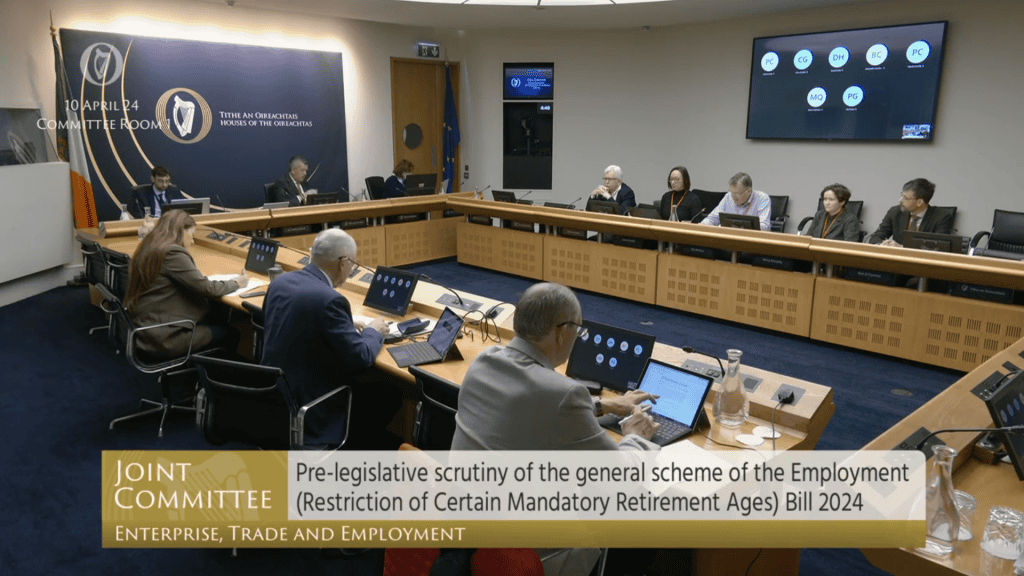
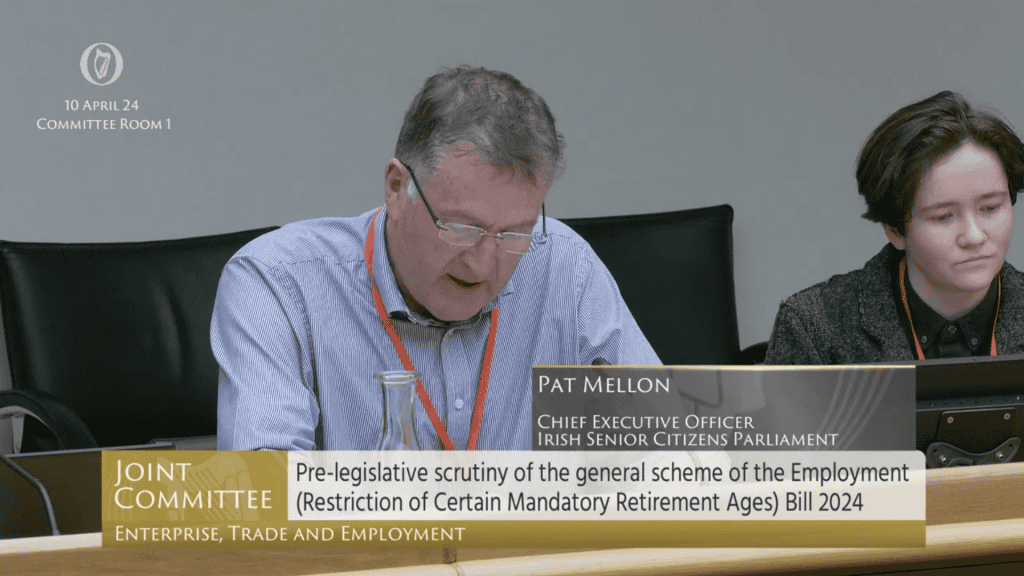
Wednesday the 10th of May was a busy day for the ISCP as we attended two Joint Committee Meetings in Leinster House with the Department of Enterprise, Trade and Employment as well as the Department of Social Protection, Community and Rural Development and the Islands. The first meeting focused on the General Scheme of the Employment (Restriction of Certain Mandatory Retirement Ages) Bill 2024 attended by our National Coordinator Pat Mellon. The aim of the measure is to restrict the enforceability of mandatory clauses in employment contracts where the employee wishes to continue in employment. As recommended by the Pensions Commission, this will deliver a statutory provision which will allow, but in no way compel, an employee to stay in employment until the State pension age.
Pat spoke to the fact that the ISCP strongly believe in the right of older people to choose their retirement age. We believe strongly in the rights of older people to continue to contribute to society in all areas, including choice regarding their working life. In the past few years, we have worked with many retired worker-staff associations whose members have similar experiences and concerns relating directly to their date and age of retirement and the lack of clarity relating to legal age for retirement. Currently, people who had to retire when they reached the age of 65 must seek social welfare benefit payment until they reach the age of 66 and cannot get the State pension or avail of supplementary benefits. He narrated the case of some women in particular who are regarded as an appendage to the assets of their husbands, which is not right.
With regard to the Bill itself, Mary Murphy of Age Action pointed out;
“The Bill does not in fact prevent mandatory retirement at the age of 65 or below; it just changes the requirements the employer must meet. It is not clear that this will even narrow the circumstances in which it can occur, or create any impediment for employers.”
The full debate is available to read HERE.
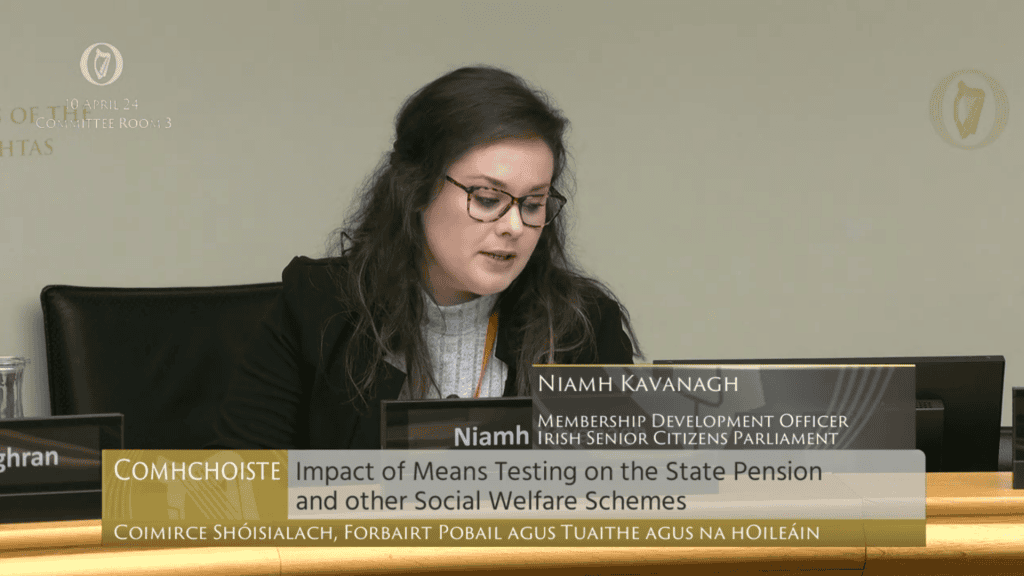
The second Joint Committee meeting discussed the impact of Means Testing on State Pension and other Social Welfare Schemes in which our MDO, Niamh Kavanagh campaigned heavily against;
“What we do not need is more ways of taxing our retirees; rather, we need a system that recognises the needs of those who have reached retirement and need to feel safe, comfortable and valued. Rather than means testing the basic needs of those who have given more than their fair share, a closer look at the pension contributions tax breaks, which very high earners can avail of, may well be a more constructive and equal approach.
There is need for an overhaul of the system to allow for a more effective support to ensure older people and those on other State transfers would have a better standard of living. The ISCP supports a review based on Social Justice Ireland’s call for a universal pension, which would solve many of the problems inherent in the system as it would provide a guaranteed income during old age for all older residents on an individual basis, without regard to anomalies in their social insurance history. It would also provide a secure and certain framework around which individuals can plan for their retirement and, over time, it would distribute income, creating a more egalitarian society.”
Nat O’Connor from Age Action put forward three alternatives to means testing which include universalism, credited social insurance and targeting payments based on other eligibility criteria, not just income or savings, such as, for example, once again giving a medical card to everyone aged 70 and older based on age and not on income.
Sean Moynihan of ALONE commented on the fact that means testing is calculated based on household rather than individual income. Negative impacts resulting from this include cases where older people have been unable to access fuel allowance due to adult children moving back into their parents’ home. Also, something the ISCP have spoken to before, means testing for the non-contributory pension for couples sufficiently impacts individual autonomy and independence in older age, not to mention financial security.
Ireland still spends less money on pensions, which is a function of Ireland’s demographic structure, and relies more heavily on means-tested social assistance rather than social insurance. However, retirement from employment continues to correlate with a decrease in income, resulting in dependence on the State pension for many individuals within Irish society. The growth in wage incomes has outpaced that of State pensions, thereby exacerbating the disparity between the incomes of retirees and employed individuals. The commitment to link the State pension to 34% of the average wage has not been realised, thereby adding further insecurity to pension provision and the gap between rich and poor.
You can read this debate in full HERE.
Senior Citizens’ Lobby of Fine Gael Ard Fheis, University of Galway.
“End this blatant and ageist discrimination against pensioners!”
After Storm Kathleen forced the parliament to postpone a larger lobby of the Fine Gael Ard Fheis, the ICSP’s national co-ordinator, Pat Mellon, led a skeleton delegation of retirees from all four provinces to the fringes of Mr Harris’ inaugural convention as leader.
The Irish Senior Citizens’ Parliament (ICSP) and its Collective Network of Retired Workers’ Organisations called on the Taoiseach-in-waiting, Simon Harris, to reverse the government’s opposition to a Private Members’ Bill aimed at giving pensioners’ representative bodies a voice at all employer-union talks which pose a threat to their pensions. This is an ongoing campaign and pensioners are not going away until the Bill is passed.
They reminded passing legislators and delegates that government opposition to Deputy Bríd Smith’s Industrial Relations (Provisions in Respect of Pension Entitlements of Retired Workers) Bill 2021 has mired it in legislative scrutiny for over a year.
Speaking to the delegation, Mr Mellon said:
“The passage of this Bill would finally address the suppression of pensioners’ rights by the Industrial Relations Act of 1946. It denies pensioners any say when decisions about their occupational pensions are being made by employers – including the state – trustees and trade unions.”
Paddy Fagan retired Dublin Airport Authority Staff member reminded the Fine Gael delegates to the Ard Fheis, that he along with over 3,000 fellow-members of the Retired Aviation Staff Association (RASA) had to raise almost three million euro to fight a 9-year High Court battle in a failed bid to recover cuts to their pensions of up to 20%. They were imposed on them by pension trustees, employers and the state following approval by trade unions they once belonged to.
However, twelve days ago, EU Commissioner Mairead McGuinness said the action confirmed that Irish law is consistent with European law in conferring on pensioners a constitutionally protected property right to the money they saved in their pension trust.
Writing to Euro-parliamentarian Clare Daly – herself a member of the IASS pension scheme and former Aer Lingus Employee – the Commissioner for Financial Services, Financial Stability and Capital Markets said the 2020 judgement was consistent with the case law of the European Court of Justice. Mr Mellon said:
“This exclusion of the pensioners of state-owned companies like Irish Shipping, the Dublin Airport Authority/Shannon Airport, Aer Lingus (now privatized) and the ESB, has resulted in significant losses of earnings for tens of thousands of retirees and their dependents. The state’s reprehensible practice of freezing pensioners out of key decisions on their fate in old age persists. But it’s worth underlining that most victims were auto-enrolled. Contributing to the schemes was a generally a condition of employment. They did this with a reasonable expectation of a fair return after retiring.
Similarly, retired civil servants reasonably expect that parity with pay rises for their still-working colleagues will continue.”
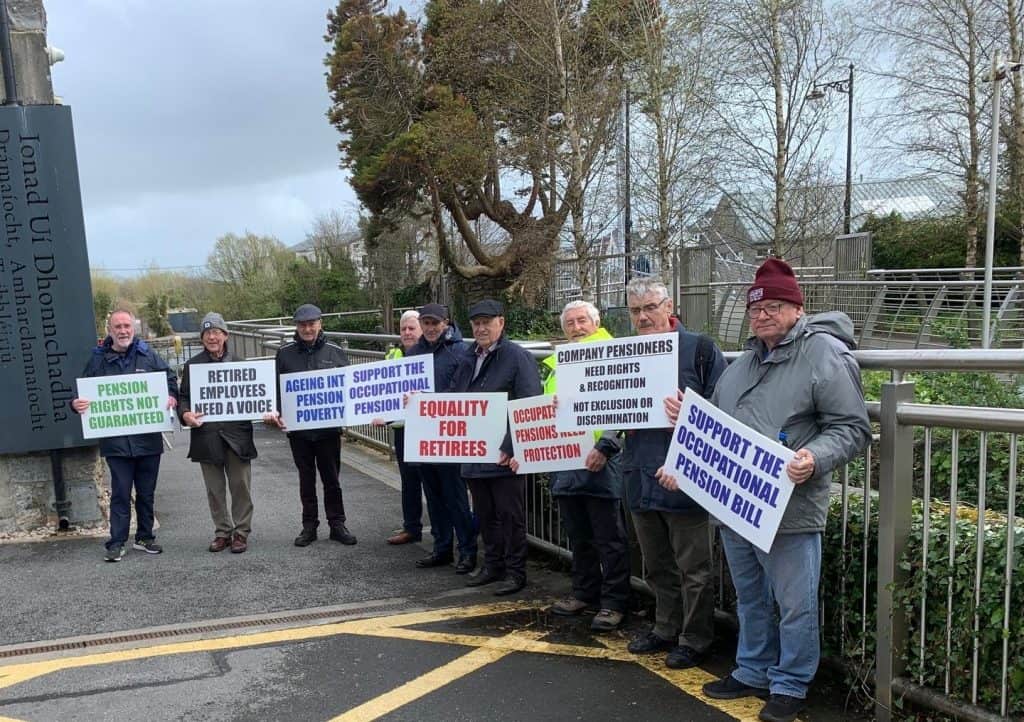
With regard to compulsory Pension Enrolment, Joe Little of the RTÉ Retired Staff Association, explained to TD’s and delegates alike; “If Mr Harris’ government is serious about last week’s decision to introduce compulsory pension enrolment for up to 750,000 uncovered private sector workers, it must follow Bríd Smith’s lead and give retired people a voice in decisions impacting their income on retirement. Otherwise enrolled employees will be press-ganged into buying a pig in a poke.”
The Senior Citizens’ Parliament calls Brid Smith’s Private Member’s Bill an Irish charter for pensioners’ civil rights. “It’s time for all TD’s and Senators to support it or face the wrath of the most dedicated age-cohort voters in the land at the coming elections. If the government continues to oppose Deputy Smith’s Bill, why would any private sector worker not avail of the two-yearly opt-out clause in the draft auto-enrolment plan?” Mr Little asked.
“As the law stands, it would be a rational response.”