
News
HAVE YOUR VOICE HEARD
The Irish Senior Citizens Parliament together with Age Action are organising Hustings around the country. We believe that gathering together and engaging with your local politicians to have your voice heard firsthand is an opportunity that we rarely have. We believe it is an opportunity, not only to emphasize the issues but also to highlight that older people are very much active contributors to society.
We held our first meeting in Multyfarnham Co Westmeath, and both the politicians and members who attended were very pleased with the discussions and engagement. The issues were wide and varied but key among them was ‘the pension’ the lived experience of carers and rural transport.
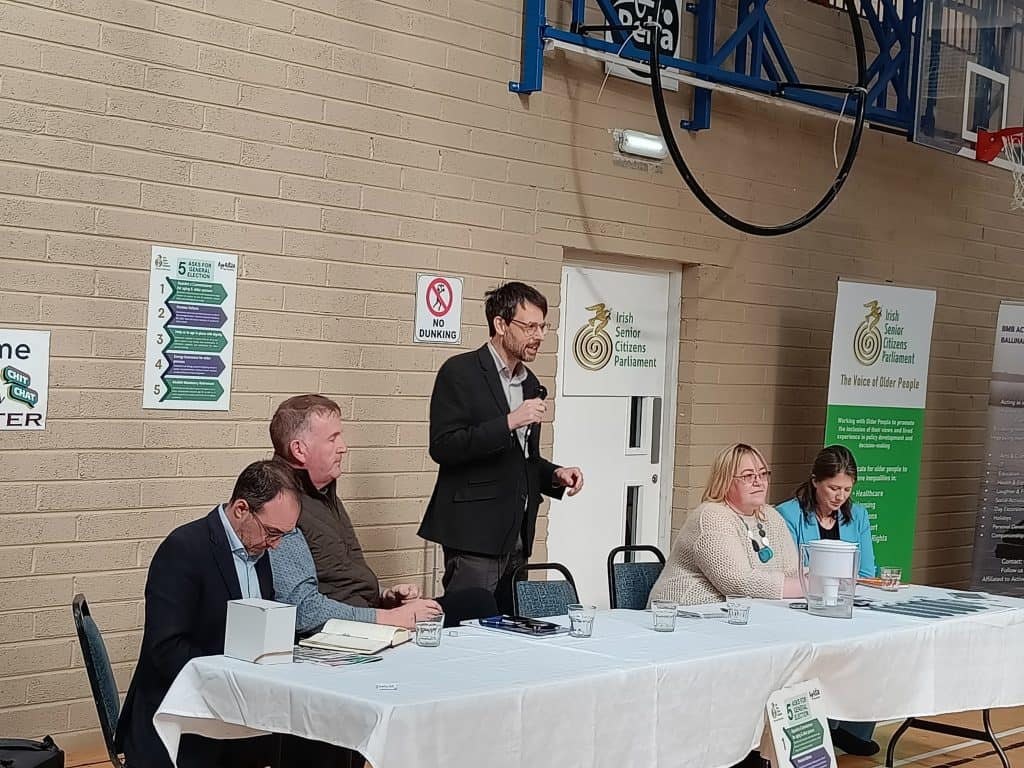
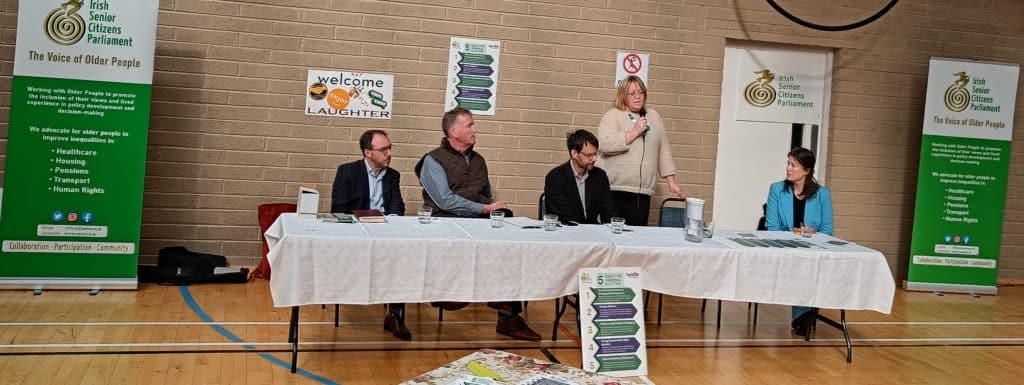
We thank the Retired Nurses Association and the BMB ARA for all their support.
NEXT EVENT
We are holding our next event in Waterford and we thank the ESB Retired Staff Association (South East) for their support for this event. We hope to see you all at the event and by your attendance you are helping us send the message to politicians that we are
RETIRED WORKERS NOT RETIRED VOTERS
VENUE: Doorleys Hotel, The Quay Waterford
DATE: 24TH OCTOBER 2024
TIME: REGISTRATION TEA & COFFEE @ 10.00/10.15
FURTHER DATES WILL BE ANNOUNCED.
THANK YOU

We are delighted to offer our sincere thanks to all our members who campaigned through letter writing, calling into their TD’s clinics and attending our rallies outside the DAIL. This hard work was to fight for for the right of older retired people to have a say, relating to their Occupational/Private Pension. This is linked to the proposed Industrial Relations Bill.
This morning (16th Oct) the Joint Committee Committee on Enterprise, Trade and Employment has determined that the Industrial Relations (Provisions in Respect of Pension Entitlements of Retired Workers) Bill 2021 should proceed to Committee stage. (Third Stage)
While we have a some way to go to have the proposed Bill enacted, and I am sure we can count on your ongoing support, it is thanks to the hard work of all involved that we are at this point. The representatives from the member organisations, have been tireless in their research and work to ensure we gave as complete a picture as possible, of the impact of having NO VOICE and how this proposed Bill will make life better for retired workers.
We thank the Joint Committee members for their time, energy and diligence in their work to date. Their engagement with us was respectful, their question were well researched and they listened to the input of the member representatives and in some cases followed up for greater clarity. Last but not least we thank Deputy Brid Smith who after hearing of the many many years of campaigning of retired workers, went away and with her colleague developed this Bill and proposed it as a Private Members Bill.
BROKEN PROMISES AGAIN

IT IS INTERESTING TO NOTE THAT THIS BUDGET WAS DELIVERED ON INTERNATIONAL DAY FOR OLDER PEOPLE
There is a history of successive Governments ‘promising’ to deliver an Ireland that values older people
……..Ireland will be a society for all ages…………It will be a society in which the equality, independence, participation, care, self-fulfilment and dignity of older people are pursued at all times. (National Positive Ageing Strategy 2013.)
This strategy commits to:
Objective 3.1 Provide income and other supports to enable people as they age to enjoy an acceptable standard of living.
This strategy was never implemented in full and is rarely referenced now.
Later still this current Government under the Road Map for Social Inclusion agreed to:
…….To protect the incomes of older people through the delivery of the commitment to benchmark State pension payments A major concern of older people, reflected in the consultation process for this Roadmap, is the security and value of State pension payments.
The Government in its Road Map acknowledged:
Recipients of social welfare payments, particularly those dependent upon longer-term payments (such as the State pension), cannot plan or budget with confidence over the medium to long-term
The Road Map also acknowledged
“In setting the rate of State pension, Ireland is currently atypical compared to other EU countries in its approach to applying discretionary increases through political decisions in the annual budgetary process………The Government believes a regime of automatic indexation would introduce greater long term certainty for our retirees.
The timeline set out for this was as follows:
The Department of Employment Affairs and Social Protection is continuing, with the Department of Public Expenditure and Reform, to explore this smoothed earnings option and has been tasked with bringing forward a proposal for consideration by Government with an approach being finalised in Q1 2020.
Apply the benchmark in adjusting Pension changes for Budget 2021. DEASP; DPER 24 Q4 2020
Timeline Subject to Government decision, develop and prepare any necessary changes to legislation to give effect to a benchmarking approach. 23 DEASP Q1 2020
We here in the ISCP are not at all surprised by the frustration, upset and downright hopelessness so many pensioners feel at yesterday’s Budget. The reality of the impact of €12 in supporting those dependent on the state pension to survive, let alone live adequately on this is a joke. Our colleague Nat O Connor from Age Action relieved to see that the state pension has gone up more than just a fiver. However, a €12 per week increase does not replace all the lost spending power since 2020. The core rate of the pension would need to be increased by a further €19, on top of the €12, to have the same spending power it had in 2020.
This was before we looked at the increase in petrol and diesel; a rise of around 2.1 cent per litre of petrol and 2.5 cent to a litre of diesel. It is worth noting that 50-60% of the amount we pay at the pumps is tax. For many older people living in rural Ireland, managing without a car is an impossibility.
Speaking after the Budget, ISCP National Coordinator Pat Mellon said: We are concerned at the lack of concern the Government has for the impact of the €12 increase. They, more than anyone, are aware of the need to link the pension to 34% of average wage if older people are to stay out of poverty. It also allows older people plan for their heavier outgoings like car tax and insurance, house repairs and maintenance.
We know from our members that trying to save on the current state pension is impossible. Pat a member from Artane explained how she tried to save for the Christmas but has found it impossible. I want to give my grandkids a small present for Christmas and their birthdays but I find myself not being able to anymore. I can do one or the other.
The unwillingness to implement linking the state pension like most other Eurozone countries was a missed opportunity. This country is awash with money and it was well within the remit of the Government to do this even over a phased basis, but they choose not to do so. Shame on them.
PLEASE LET YOUR POLITICIANS KNOW HOW YOU FEEL WHEN THEY COMEW TO ASK FOR YOUR VOTE IN THE GENERAL ELECTION