News
Minimum Essential Standard of Surviving
“Due to the cost-of-living crisis, anything less than a €27.50 adjustment in core social welfare rates will be a real term cut. This is the absolute minimum required to prevent individuals and families being pulled deeper into poverty.”
-Vincentian MESL Research Centre Pre-Budget 2024 Submission
The Minimum Essential Standard of Living (MESL) research was transferred from the Vincentian Partnership for Social Justice, to the Vincentian MESL Research Centre at the SVP in July 2022. The MESL research has been ongoing since 2004. The MESL budget standards research has developed to provide an evidence-based benchmark of what is required for a life with dignity for 90% of households in Ireland, and has become an integral part of the policy discourse around income adequacy, poverty and social inclusion.
The MESL expenditure needs dataset is adjusted annually for all household types, to reflect changes in prices. The income calculations used in the Minimum Income Standard (MIS) analysis and the MISc.ie calculator web application are updated each year, incorporating all relevant changes to social welfare and taxation.
The most recent MESL Annual Update Report 2023 has revealed that the cost of the MESL ‘Basket’ has increased by an average of 10.6% nationally predominately driven by the rising cost of food and energy. The MESL basket identifies minimum goods and services that everyone should be able to afford. However, the core MESL basket also assumes that the household is in good health, does not have a disability and also excludes housing, childcare and secondary benefits.
Although the parameters of the MESL Calculations have been reviewed and updated due to the recent hike in the cost of living, they are still based on multiple assumptions which do not accurately reflect the reality for thousands of older persons in Ireland:
- It is assumed that the older person is receiving the highest pension rate of €254 (non-contributory) or €265.30 (contributory)
- The budget allocated to mortgage or rent payments only ranges from €36.60 to €56.70 per week
- The report assumes that the older person is also in receipt of the majority of all bonuses and allowances
- Older persons are also considered to be a full medical card holder
You can view the figures on the MESL 2023 Appendix Tables HERE.
Even with the above assumptions, the MESL research found that the cost of a Minimum Essential Standard of Living for an older single adult living alone has increased significantly since 2022. One-off income supports or additional weekly allowances have not kept pace with the rise in inflation, which demonstrates income inadequacy in 2023.
As we have mentioned in previous articles, the Survey on Income and Living Conditions (SILC) 2022 revealed that persons aged 65 and older had the highest increase in the ‘at risk of poverty’ rate going from 11.9% in 2021 to 19.0% in 2022. As we hear from more and more older persons who are struggling, we imagine that the number of people at risk of poverty has dramatically increased since 2022 and indeed the number of older persons who have since crossed this poverty line.
“The 2023 analysis finds that, for the first time since 2017, neither the Contributory nor Non-Contributory State Pension will provide the basis of an adequate income for an urban older person living alone.”
– Vincentian MESL 2023 Impact Briefing
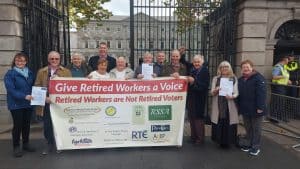
The Pension Promise Coalition (ISCP, SIPTU, NWCI, Age Action, ARI) have just completed one round of public meetings as part of a campaign where we have been calling on the Government to deliver on its previous commitment to benchmark the state pension at 34% of average earnings. If this system was introduced by next year, the increase would equate to approximately €53 extra per week. The Pension Promise Coalition, Alone Ireland, the European Anti-Poverty Network (EAPN) and multiple other age organisations are calling for the benchmarking of social welfare payments against a level that is adequate to lift people above the poverty line and provide them with at least a minimum standard of living.
Everyone deserves an equal standing in society, an equal opportunity to participate in their community and equal access to an average standard of living. The ISCP continues to try to address this injustice and to ensure that every older person will have security in retirement.
Get the FACTS about the State Pension!
What is the current rate of the state pension?
€265.30 for the contributory state pension and €253 for the non-contributory state pension. Only two-thirds of recipients get the full rate.
What would the rate of the state pension be if it was benchmarked to average earnings?
In 2024, it would be €318/week, €53 more than the top rate contributory state pension at present.
Why should the state pension be 34% of average earnings?
First proposed in 1998, this pledge is developed in The Roadmap for Pensions Reform 2018-2023 and The Roadmap for Social Inclusion 2020-2025, and a technical analysis of the benchmark is conducted as part of the Report of the Commission on Pensions. The Minister for Social Protection has pledged to bring an “input” on benchmarking the state pension into Budget 2024, but this is not the legal certainty that is required.
The 34% benchmark would go some way to reducing the high pension inequality faced by women, carers and people with disabilities.
Will 34% of average earnings eliminate poverty among older people?
No, unfortunately not. But it will provide security because people will know that the pension will increase automatically. Benchmarking would take the politics out of the state pension.
Pension income would need to be 40-50% of average earnings to ensure people are not in poverty in older age. People will need to save for retirement to maintain their living standards, including via auto-enrolment and the important role of occupational pension schemes and personal pension savings.
Why earnings not inflation?
Earnings grow more over time, therefore benchmarking the state pension against earnings will provide older people with a fair share of economic prosperity.
But both is better, which the government has acknowledged in the proposal for ‘smoothed benchmarking’, which will link the state pension to average earnings but give a boost to pension incomes when inflation is higher than earnings growth, after which earnings will have to catch up before the pension would go up again.
Why is legal certainty about benchmarking required?
Without legal certainty, the state pension rate would remain a ‘political football’ in the annual budget, which is why it should be automatic—just like the government is proposing for the annual indexation of income tax bands against inflation.
Weren’t the €12 and one-off payments enough?
No, while welcome, the state pension still lost spending power despite the €12 increase. The one-off payments were not enough to bridge the gap, plus not everyone got them and they only last for one year after which the lost spending power is even more of a problem.
Is it affordable to raise the state pension?
Yes. Raising it by €53/week would cost approximately €1.7 billion/year, at a time when tax and PRSI revenue was €35.4 billion higher in 2023 compared to 2020, which is an increase of over 52%. While revenue linked to multinational corporations may be unsustainable, the state still has strong public finances that can afford to lift older people out of poverty.
In 2021, Irish public spending on old age social protection was 3.5% of GDP or 6.4% of modified GNI, making Ireland the second lowest spender on old age social protection in the EU. The average across the EU was 10.8% of GDP.
Isn’t the Irish state pension rate one of the highest in Europe?
It is sometimes said that the rate of the Irish state pension is higher than in most other EU countries, but this is a deceptive claim.
In Ireland, there is only one tier of state pension providing a basic rate for all, with not everyone getting the full rate. In every other EU country, there is a second tier, top-up state pension based on previous earnings or contributions in addition to the basic rate.
In 2021, in Ireland, pensions from all sources received by people aged 65-74 replace 39% of the earnings from work of people aged 50-59. The EU average was 58% and the highest rates were 81% in Luxembourg and 79% in Spain. Because of the lack of a second tier, Ireland’s pension system had the third lowest income replacement rate in the EU.
Aren’t poverty levels among older people low?
No level of poverty is acceptable, especially for an older person who has no capacity to earn more money to change their circumstances.
The Survey of Income and Living Conditions (SILC) 2022 showed that one in five people aged 65 or older (19%) was at risk of poverty, up from one in ten (9.8%) in 2020.
One in three (33.6%) older people living alone was at risk of poverty, up from one in five (20.5%) in 2020.
Has keeping the state pension age at 66 made raising the state pension unaffordable?
No. Ireland has one of the youngest populations in Europe, and will still have the sixth youngest population by 2070, according to Eurostat projections. This means that we will have the economic capacity to fund a decent state pension and a pension age of 66.
We do have to increase funding for the state pension due to our ageing population, but most of the extra cost is due to the good news that more people are living longer. The Commission on Pensions found that raising the pension age to 68 would only reduce the cost by 16%, with 84% of the extra cost of the state pension due to growing numbers of older people. The Commission calls for PRSI increases to cover the cost of the state pension.
As shown earlier, Ireland’s spending on old age social protection is among the lowest in the EU, so there is a lot of scope to increase that spending without going beyond typically European levels.
Click here to download a PDF version of the Fact Sheet!
The State Pension is a real Shame!
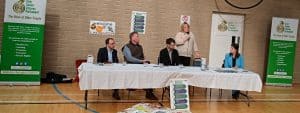
The Pension Coalition launched the beginning of a series of townhall meetings on Monday 19th June at Liberty Hall in Dublin. The purpose of the townhall meetings is to raise awareness of the inadequacy of the state pension and the need to raise the pension rate to 34% of average earnings. This figure of 34% was first proposed by the Government almost 25 years ago and was once again promised in 2018 in the Roadmap for Pensions Reform 2018-2023.
At the Dublin launch on Monday, representatives from each organisation in the Pension Coalition spoke about the inequalities and impoverished consequences for people relying on the state pension. The Coalition is made up of 5 organisations including the Irish Senior Citizens Parliament, Age Action, Active Retirement Ireland (ARI), SIPTU and the National Women’s Council of Ireland.
Nat O’Connor of Age Action highlighted the gross underfunding in overall social welfare and pension systems in Ireland in comparison to other EU countries. Both Nat and SIPTU researcher Michael Taft dismissed the misconception of the Irish Pension system being a ‘Ticking Timebomb’, advising that there is plenty of funds to support a sufficient and more sustainable pension system.
Our own CEO Sue Shaw and ARI CEO, Maureen Kavanagh demonstrated the lived experience of the people who rely on the state pension and who are struggling every day just to keep the lights on. The two organisations recently conducted membership surveys in which they revealed staggering statistics on the effects of trying to balance the low pension rate against the high cost of living. We even heard from audience members who wanted to let people know just how difficult life has been since the rise in cost of living. Geraldine Murphy spoke about the heartache in having to decide between paying for much-needed vet bills for her dog or fixing a leak in her roof.
No one should have to make these kinds of sacrifices let alone a pensioner who has worked their entire life in order to have the opportunity to enjoy their retirement. This opportunity has been taken away from so many, with people now dreading the day they must retire. We have reached out to people like Geraldine to ask if they would come forward and speak about their experience of living on the state pension. We were truly shocked and saddened to hear that nearly every person was too ashamed and embarrassed of letting anyone know that they were struggling or that their only income came from the state pension. At what point did this sense of shame get attached to the state pension? And how can the Government sit back and let this continue to happen?
The Government needs to keep their promise of a state pension rate of 34% of average earnings to enable people to live at an acceptable standard.
We wish to thank everyone who attended the launch on Monday in Dublin. We would love to continue seeing this support at our next few events. Please see dates below of our upcoming townhall meetings that might be coming to a town near you:
Scam Text Messages in full force!
We have received multiple reports of scam text messages doing the rounds and they can be very convincing. Scam text messages usually come from an unknown number claiming to be someone like Revenue or An Post, for example. The text messages often contain a link and asks you to click on the link which takes you to a website, where you might be asked to provide personal details.
NEVER REPLY to any of these text messages!
NEVER CLICK ON ANY LINK OR WEB ADDRESS contained within these texts!
A newer type of scam text being circulated is from someone claiming to be a relative or friend who is stuck in a bind. Our own staff members have received a text message asking or help from mum, claiming that their phone is broken and that they have gotten a new phone number. In this instance, the scammer asks you to reply to this ‘new number’ either by text or on Whatsapp.
NEVER REPLY to any of these text or Whatsapp messages!
If you are ever in doubt, DO NOT RESPOND!
Here are some screenshots of text messages that some of our members have received: